How raw MS and SS sheet becomes a finished electrical enclosure — laser cutting vs CNC punching, press-brake bending tolerances, weld finishing and choosing the right metal grade and thickness.

Every electrical enclosure starts life as a flat sheet of metal. The manufacturing steps between that raw sheet and a finished, IP-rated enclosure determine its strength, fit, finish and long-term durability — and they're the part of enclosure manufacturing that's easiest to get wrong if a fabricator cuts corners. Here's how the process actually works, and what to check for when evaluating an enclosure manufacturer in India.
Most electrical and industrial enclosures are fabricated from cold-rolled mild steel (MS) or stainless steel (SS304 / SS316). MS is the economical, high-strength default for indoor panels and control enclosures that will be painted or powder-coated. SS304 is the standard choice where corrosion resistance matters — food, pharma or general outdoor use — while SS316 adds molybdenum for better resistance to chlorides, making it the right call for coastal sites, marine-adjacent installations or chemical exposure.
Sheet thickness is usually specified in gauge or millimetres (typically 1.2mm–3mm for enclosure bodies, heavier for structural frames and door hinges). Too thin, and a panel door will flex, seals will fail to compress evenly, and the enclosure won't hold its IP rating under vibration. Too thick adds unnecessary cost and weight without a functional benefit — matching thickness to the actual mechanical and IP requirement is a big part of what separates good enclosure engineering from a generic off-the-shelf box.
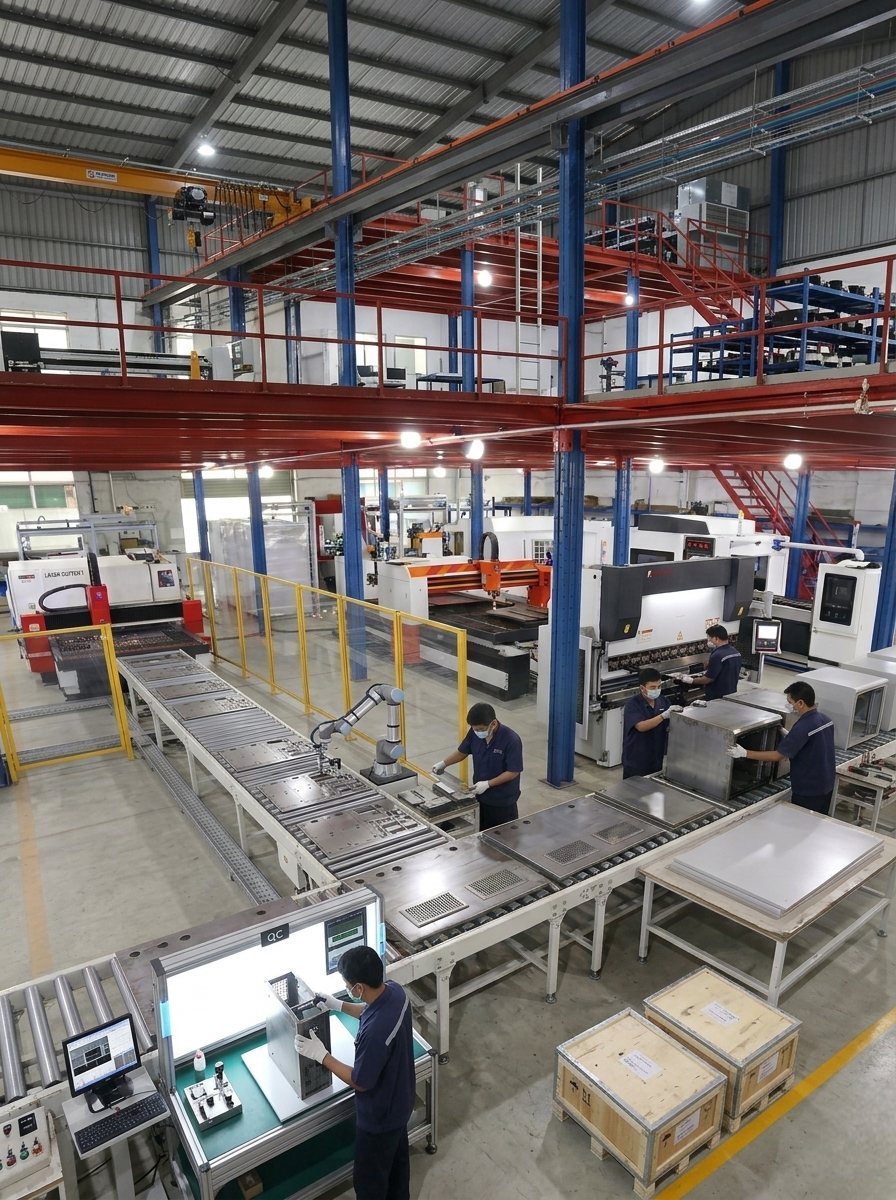
Laser cutting uses a focused, computer-controlled beam to cut precise profiles directly from a CAD drawing — ideal for complex cutouts, tight tolerances, cable-gland knockouts and one-off or low-volume custom panel designs, with a clean edge that needs minimal deburring.
CNC punching uses a turret of tooling to punch shapes mechanically. For simple, repeated hole patterns at higher volumes it can be faster and more economical than laser cutting, though it's less flexible for entirely custom geometries. Most enclosure manufacturers use a combination of both — laser cutting for custom and low-volume work, punching for high-repeat standard patterns — and CNC bending (press-brake forming) after cutting to fold the flat blank into its final 3D shape along precisely programmed bend lines.
A press brake forms the cut blank into its box shape using a punch and die under controlled tonnage. Bend allowance — how much extra material a bend consumes — has to be calculated correctly for the metal's thickness and grade, or the finished enclosure's external dimensions won't match the drawing and doors or mounting points won't align.
Where a design calls for a fully seam-welded (rather than folded-and-fastened) body, corners are welded and then ground and finished smooth — important both for appearance and because a rough weld seam can compromise a gasket's seal and drop the enclosure's IP rating. Welded enclosures generally offer better rigidity and a higher IP rating than fastened/riveted assemblies, which is why fully welded construction is often specified for outdoor, washdown or higher IP-class enclosures.
After fabrication, MS enclosures are typically degreased, phosphated and powder-coated — an electrostatically applied dry powder cured under heat into a hard, even, corrosion-resistant finish available in any RAL colour. Powder coating outperforms wet paint on durability and consistency for industrial use. Stainless steel enclosures are usually left in a brushed or passivated finish rather than painted, since the metal's own corrosion resistance is the point of specifying it.
Two enclosures can look identical in a photo and behave very differently in the field if the underlying fabrication quality differs — bend accuracy, weld finish, powder-coat adhesion and gasket-groove tolerance are all determined at the fabrication stage, not afterward. This is why VERCHO Group treats sheet metal fabrication as core engineering, not just a cutting step: precise laser cutting and CNC bending, proper weld finishing and consistent powder coating are what let an enclosure actually hold its rated IP class for years in the field, not just on a datasheet.
For the IP ratings themselves, see our complete IP ratings guide, and for how these fabrication choices map to welded vs. modular enclosure formats, see types of electrical enclosures.
For any question, please write to us at info@verchogroup.com — or send it straight from this page. Our engineering team will reply by email.