Mild steel, stainless 304 or 316, aluminium or polycarbonate? How each enclosure material performs, what it costs and which one suits indoor, outdoor, coastal, food and chemical sites.
Mild steel, stainless steel 304 or 316, aluminium or polycarbonate? The material of an electrical enclosure decides how long it survives on site, how much it weighs, what it costs and how it must be finished. This guide explains each option, compares them side by side and shows which one suits which environment.
An enclosure protects switchgear, drives, PLCs and instruments from dust, water, impact and tampering — for 15 to 25 years in many plants. The IP rating tells you how well the enclosure seals when it is new. The material decides whether it still seals after ten monsoons, a coastal breeze full of salt, daily wash-downs or a chemical splash.
Choosing the wrong material is expensive in both directions. Mild steel in a coastal plant rusts through at the hinges and gland plate within a few years; stainless 316 in a dry indoor control room costs two to three times more than it needs to. The right choice starts with the environment, not the price list.
Cold rolled close annealed (CRCA) mild steel is the most common enclosure material in India. It is strong, easy to laser cut, bend and weld, and it is the most economical metal option. On its own, mild steel rusts — so its life depends entirely on the surface treatment and powder coating applied over it.
Pre-galvanised (GI / GP) sheet and electro-galvanised sheet add a zinc layer under the paint, which slows rust from scratches and cut edges. They are a good middle step between plain mild steel and stainless steel for outdoor kiosks and solar combiner boxes.
SS 304 contains roughly 18 % chromium and 8 % nickel. The chromium forms a thin, self-healing oxide film, so the steel does not need paint to resist rust. Enclosures are usually supplied with a brushed (No. 4) or satin finish, which also hides small scratches.
SS 316 adds about 2–3 % molybdenum, which greatly improves resistance to chlorides and many chemicals. 316L is the low-carbon version, preferred for welded enclosures because it resists corrosion along weld lines.
Aluminium weighs about one third as much as steel. It forms its own protective oxide layer and is usually powder coated or anodised for appearance and extra protection. Cast aluminium is common for small, heavy-duty junction boxes and for many flameproof (Ex d) enclosures; sheet aluminium is used where weight matters.
Polycarbonate enclosures are moulded, tough and often available with transparent covers. GRP / FRP (glass-reinforced polyester) enclosures are rigid and highly resistant to chemicals and UV. Neither material rusts, and both are electrical insulators, so the enclosure itself does not need to be earthed in many applications.
| Material | Density (g/cm³) | Corrosion resistance | Strength | Relative cost |
|---|---|---|---|---|
| Mild steel (CRCA), powder coated | 7.85 | Depends on coating | High | Low |
| Galvanised steel, powder coated | 7.85 | Good | High | Low–medium |
| Stainless steel 304 | 7.93 | Very good | High | Medium–high |
| Stainless steel 316 / 316L | 7.98 | Excellent | High | High |
| Aluminium | 2.70 | Good | Medium | Medium |
| Polycarbonate / GRP | 1.2–2.0 | Excellent (no rust) | Low–medium | Low–medium (small sizes) |
| Installation environment | Recommended material |
|---|---|
| Indoor, dry control room or electrical room | Mild steel, powder coated |
| Indoor factory floor with dust and oil mist | Mild steel, powder coated, with a good gasket |
| Outdoor, urban or industrial, inland | Galvanised or mild steel with a full pretreatment and outdoor polyester powder, or SS 304 |
| Coastal, marine, ports, desalination | SS 316 / 316L, or GRP |
| Food, beverage and pharma (hygienic) | SS 304, or SS 316 where cleaning agents are aggressive |
| Daily wash-down, chemical splash | SS 316 or GRP |
| Weight-critical: pole-mounted, rooftop, transportable | Aluminium |
| Small field junction boxes in corrosive areas | Polycarbonate or GRP |
Take a wall-mounting enclosure of 800 × 600 × 300 mm. Its body and door use roughly 1.8 m² of sheet (front and back 2 × 0.48 m², sides 2 × 0.24 m², top and bottom 2 × 0.18 m²), before flanges, mounting plate and gland plate:
Weight matters for wall strength, pole mounting, transport and handling on site. You can check any sheet, plate or section weight with our free metal weight calculator.
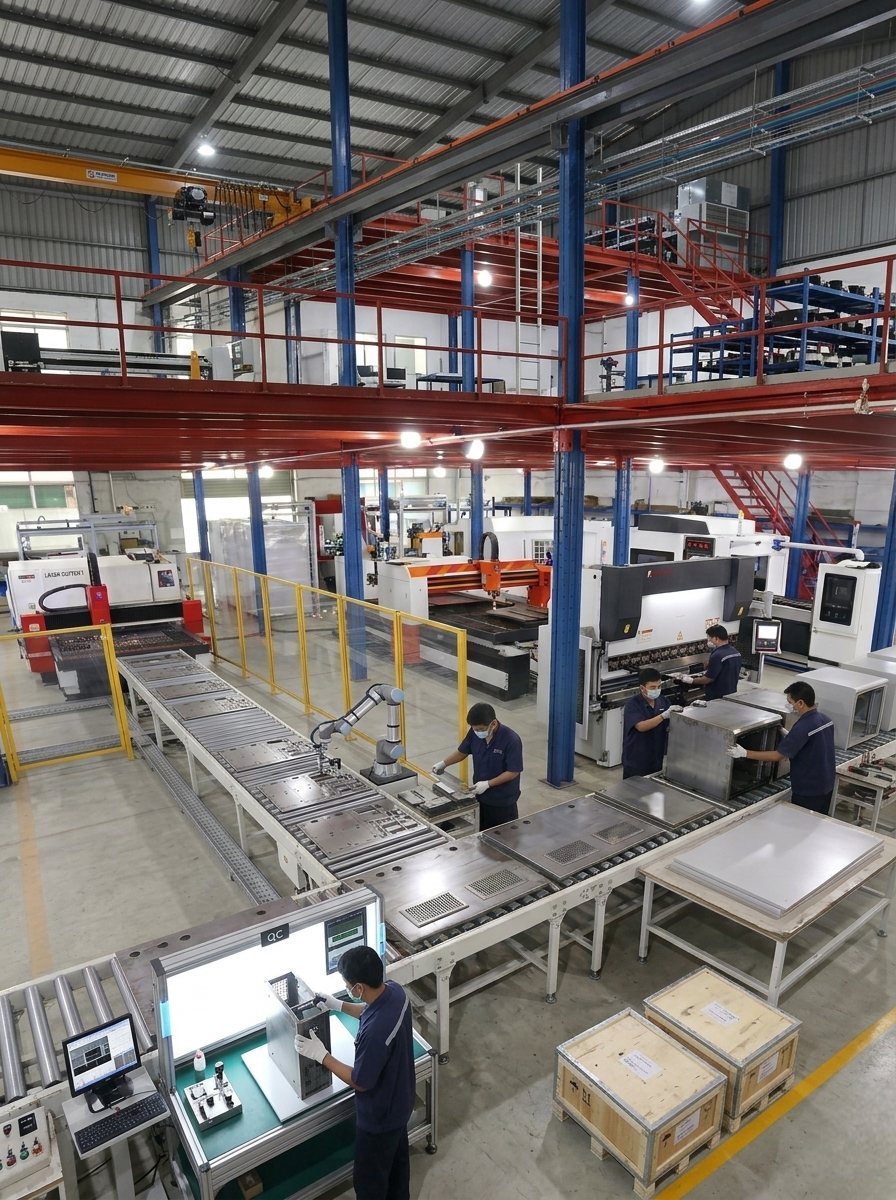
VERCHO Engineering Solutions manufactures welded, modular and semi-modular enclosures in mild steel and stainless steel, along with the locks, hinges and fasteners that go with them. Tell us where the enclosure will be installed, what it will hold and the IP rating you need, and we will recommend the material, thickness and finish. Write to info@verchogroup.com.
Related reading: types of electrical enclosures, IP ratings explained and sheet metal fabrication for enclosures.
For any question, please write to us at info@verchogroup.com — or send it straight from this page. Our engineering team will reply by email.