IEC 61439 in plain words — its parts, original vs assembly manufacturer, the 13 design verifications, routine verification, ratings such as Icw and RDF, and forms of separation.
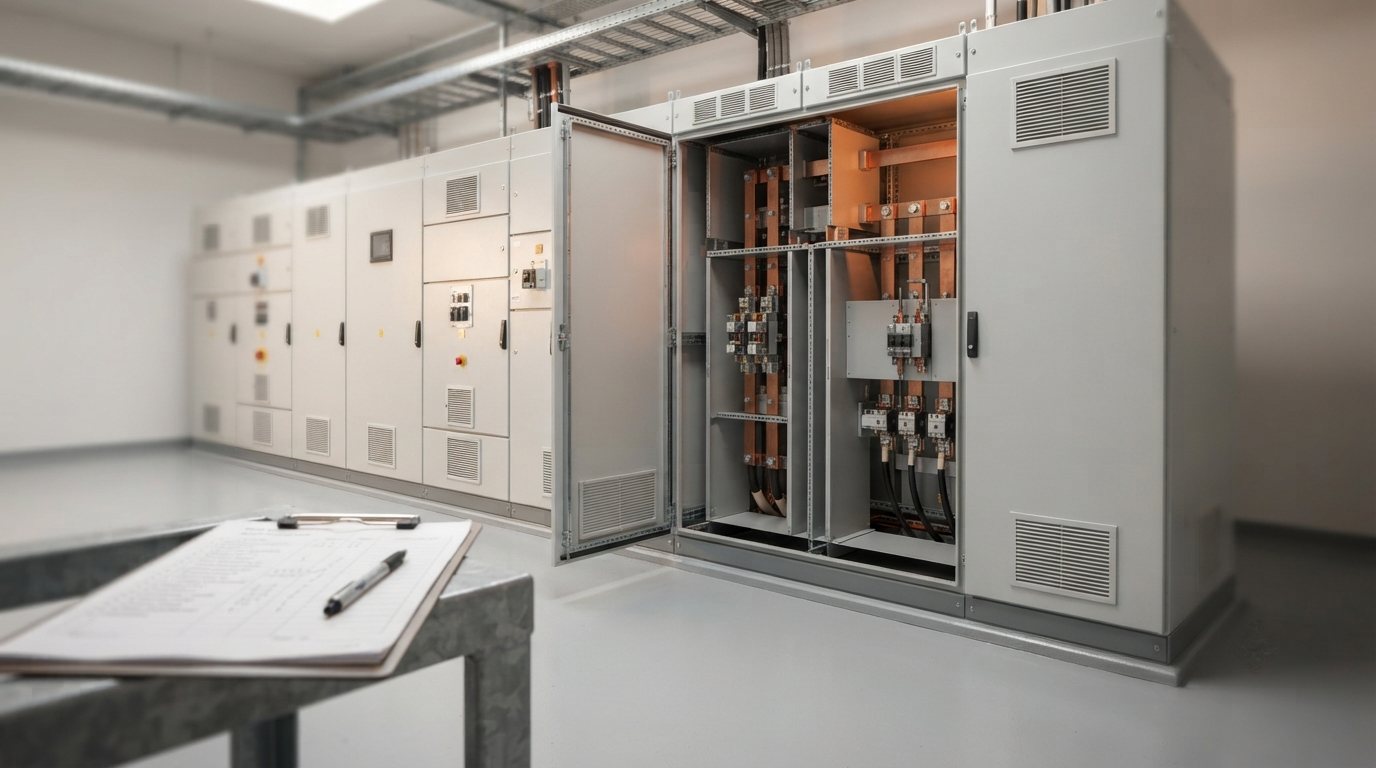
IEC 61439 is the international standard for low-voltage switchgear and controlgear assemblies — the panels, MCCs, PCCs and distribution boards that sit at the heart of every plant and building. It replaced the older IEC 60439 and changed how panels are proven safe. This guide explains what IEC 61439 covers, its parts, design and routine verification, forms of separation, and what it means for panel builders and buyers in India.
IEC 61439 applies to low-voltage assemblies: rated voltage up to 1000 V AC or 1500 V DC. It covers power distribution boards, motor control centres, distribution boards for buildings, panels used on construction sites, cable distribution cabinets and busbar trunking systems. In India it is adopted as IS/IEC 61439.
An assembly here means the complete combination: enclosure, busbars, switching devices, wiring and internal partitions. Each device inside (an MCCB, for example) has its own product standard; IEC 61439 proves the whole assembly works safely together.
| Part | Covers |
|---|---|
| IEC 61439-1 | General rules — used together with one of the product parts below |
| IEC 61439-2 | Power switchgear and controlgear assemblies (PSC-assemblies): PCCs, MCCs, industrial control panels |
| IEC 61439-3 | Distribution boards intended to be operated by ordinary persons (DBO) |
| IEC 61439-4 | Assemblies for construction sites (ACS) |
| IEC 61439-5 | Assemblies for power distribution in public networks |
| IEC 61439-6 | Busbar trunking systems (busways) |
| IEC 61439-7 | Assemblies for specific applications such as marinas, camping sites, market squares and EV charging stations |
Note: Part 1 is never used on its own. A panel is declared to, for example, "IEC 61439-1 and -2".
They can be the same company. A panel builder who uses a tested system must build it exactly as the original manufacturer's instructions say; changes outside those rules need new verification.
Design verification proves that a design meets the standard. IEC 61439-1 lists the characteristics that must be verified:
| # | Characteristic |
|---|---|
| 1 | Strength of materials and parts (corrosion, UV, heat, lifting, impact, marking) |
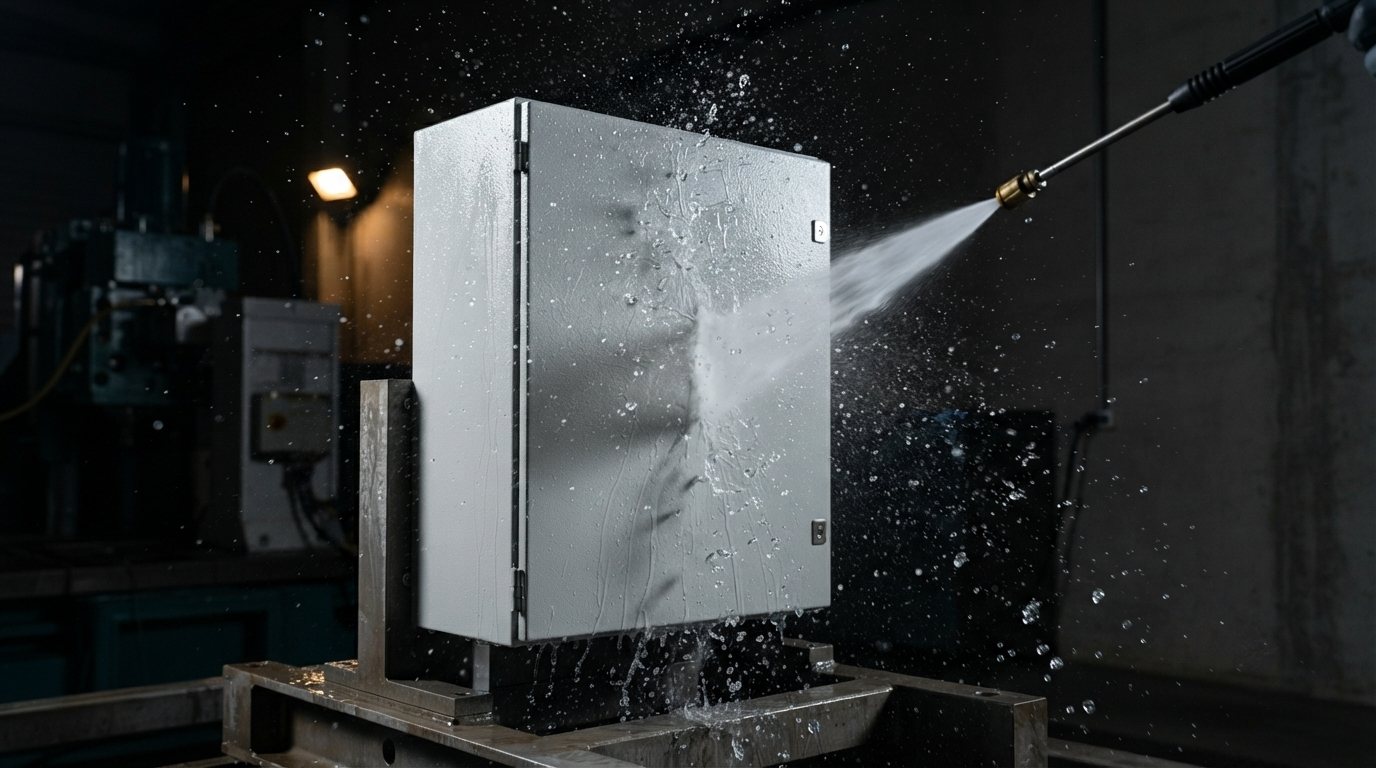
| 2 | Degree of protection of enclosures (IP code) |
| 3 | Clearances |
| 4 | Creepage distances |
| 5 | Protection against electric shock and integrity of protective circuits |
| 6 | Incorporation of switching devices and components |
| 7 | Internal electrical circuits and connections |
| 8 | Terminals for external conductors |
| 9 | Dielectric properties |
| 10 | Temperature-rise limits |
| 11 | Short-circuit withstand strength |
| 12 | Electromagnetic compatibility (EMC) |
| 13 | Mechanical operation |
Depending on the characteristic, verification is done by testing, by comparison with a tested reference design, or by assessment (calculation or design rules). Some, such as short-circuit withstand, have tight limits on when anything other than testing is allowed. Temperature rise can be verified by test, by comparison, or for smaller assemblies by calculation — the same heat balance thinking explained in why electrical panels overheat.
Routine verification is done on every assembly before delivery, by the assembly manufacturer. It checks that the panel has been built correctly. It typically includes:
| Rating | Meaning |
|---|---|
| Un / Ue | Rated voltage / rated operational voltage |
| Ui | Rated insulation voltage |
| Uimp | Rated impulse withstand voltage |
| InA | Rated current of the assembly |
| Inc | Rated current of a circuit |
| Icw | Rated short-time withstand current (e.g. 50 kA for 1 s) |
| Ipk | Rated peak withstand current |
| Icc | Rated conditional short-circuit current (with a specified protective device) |
| RDF | Rated diversity factor — the fraction of their rated current that outgoing circuits can carry continuously at the same time |
The RDF is often overlooked. If a panel's RDF is 0.8, outgoing circuits loaded together should not exceed 80 % of their rated current unless the panel was verified for more.
For IEC 61439-2 assemblies, internal partitions are described by a form. Higher forms give more protection when working on one part while others stay live, and limit the spread of faults.
| Form | Separation |
|---|---|
| Form 1 | No internal separation |
| Form 2a / 2b | Busbars separated from functional units; terminals not separated from busbars (2a) or separated (2b) |
| Form 3a / 3b | As Form 2, plus functional units separated from each other; terminals not separated from busbars (3a) or separated (3b) |
| Form 4a / 4b | As Form 3, plus terminals of each functional unit separated from other units; terminals in the same compartment as their unit (4a) or in a separate compartment (4b) |
Form 4b is common for critical MCCs and PCCs; Form 2 or 3 for many industrial distribution panels. The required form should be agreed between buyer and panel builder — see switchgear panel construction types.
The enclosure is part of design verification: its IP rating (see IP55 vs IP65 vs IP66), strength and lifting, corrosion resistance, resistance to UV for outdoor plastics, earth continuity of doors and covers, and its role in heat dissipation all matter. Choosing an enclosure with clear test data and following the maker's assembly instructions makes verification much easier. Sheet thickness and construction also matter — see sheet metal thickness for enclosures.
VERCHO Engineering Solutions manufactures enclosures for panel builders building assemblies to IEC 61439 / IS/IEC 61439, with the IP ratings, partitions, gland plates and earthing provisions they need. Browse VERCHO electrical enclosures or write to info@verchogroup.com.
This article is a general overview. Always work from the current edition of the standard for design and verification.
For any question, please write to us at info@verchogroup.com — or send it straight from this page. Our engineering team will reply by email.