Typical sheet thickness for enclosure bodies, doors, mounting plates, gland plates and frames, SWG to mm, why stiffness matters, and how material changes the choice.
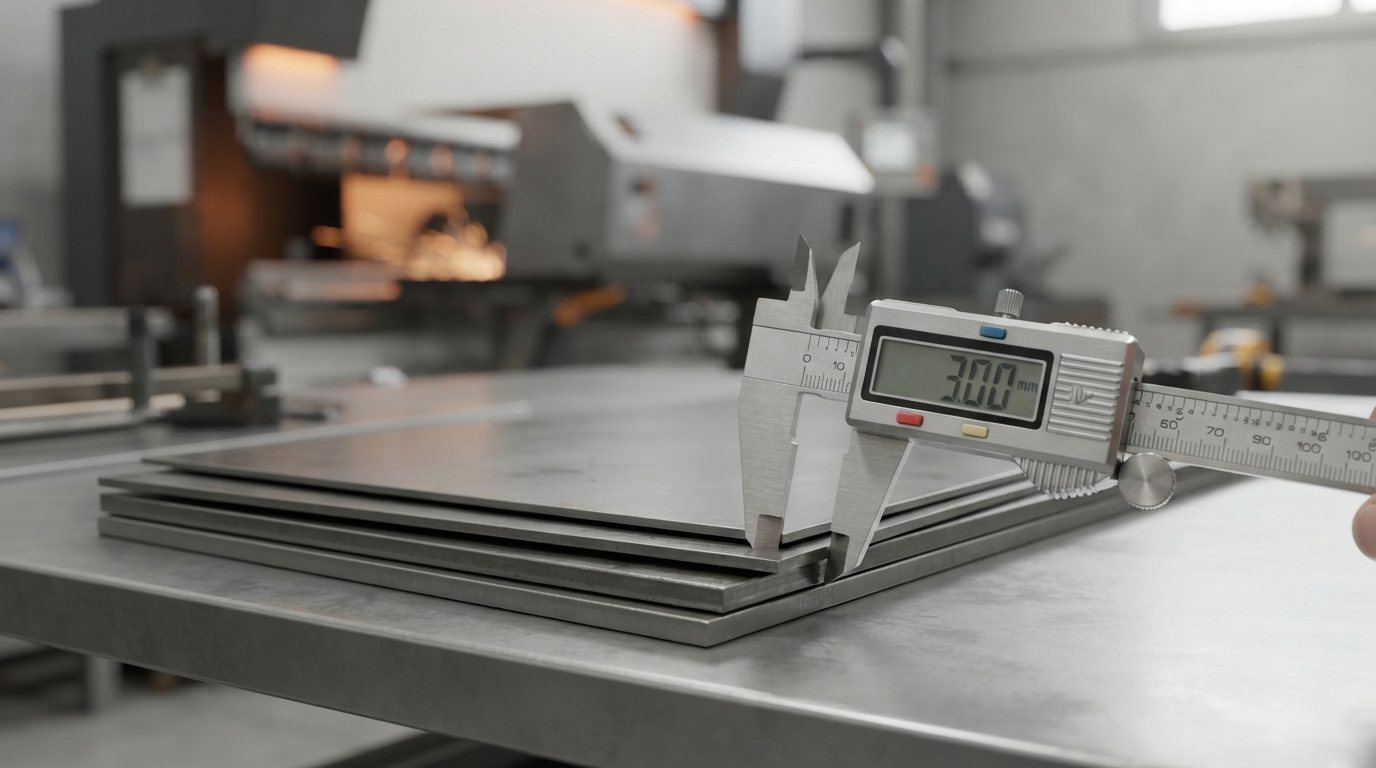
Too thin and an enclosure flexes, the door sags and the gasket stops sealing. Too thick and you pay for steel, weight and bending tonnage you don't need. This guide explains how to choose sheet metal thickness for each part of an electrical enclosure — body, door, mounting plate, gland plate and frame — in mild steel, stainless steel and aluminium.
Sheet thickness in India is often still quoted in SWG (Standard Wire Gauge). The higher the gauge number, the thinner the sheet. Specify in millimetres to avoid confusion.
| SWG | Thickness (mm) | Nearest common sheet (mm) |
|---|---|---|
| 10 | 3.25 | 3.0 |
| 12 | 2.64 | 2.5 |
| 14 | 2.03 | 2.0 |
| 16 | 1.63 | 1.6 |
| 18 | 1.22 | 1.2 |
| 20 | 0.91 | 1.0 |
| Part | Small wall-mounting (up to about 600 mm) | Large wall-mounting | Floor-standing panels |
|---|---|---|---|
| Body / shell | 1.2 mm | 1.5–1.6 mm | 1.6–2.0 mm |
| Door | 1.2 mm | 1.5–1.6 mm, with stiffeners | 1.6–2.0 mm, with stiffeners |
| Mounting plate | 2.0 mm | 2.5 mm | 2.5–3.0 mm |
| Gland plate | 2.0 mm | 2.0–3.0 mm | 3.0–4.0 mm |
| Frame / structure | — | — | 2.0–3.0 mm |
| Partitions and covers | — | 1.2–1.6 mm | 1.6–2.0 mm |
| Base frame / plinth | — | — | 3.0–4.0 mm or ISMC channel |
These are typical industry values, not limits from a standard. Project specifications, especially for switchgear, often state minimum thicknesses — see our switchgear design standards and gauge guide.
For most enclosures the limit is stiffness, not breaking strength. Bending stiffness of a flat sheet rises with the cube of its thickness:
Stiffness ∝ t³ ⇒ (2.0 / 1.6)³ ≈ 1.95
Going from 1.6 to 2.0 mm nearly doubles the stiffness of a flat panel while adding only 25 % weight. But design can be just as effective: a return flange along a door edge, a pressed stiffener welded behind a large door, or a folded channel in a frame often stiffens more than extra thickness, at lower cost.
VERCHO Engineering Solutions laser cuts, bends and welds enclosures in CRCA, stainless steel and aluminium, choosing thickness and stiffening to suit your load and site. Read about our sheet metal fabrication process, browse VERCHO electrical enclosures or write to info@verchogroup.com.
For any question, please write to us at info@verchogroup.com — or send it straight from this page. Our engineering team will reply by email.