The common causes of electrical panel overheating, how to check the heat balance, filter fan sizing with a worked example, and cooling options from louvres to air conditioners.
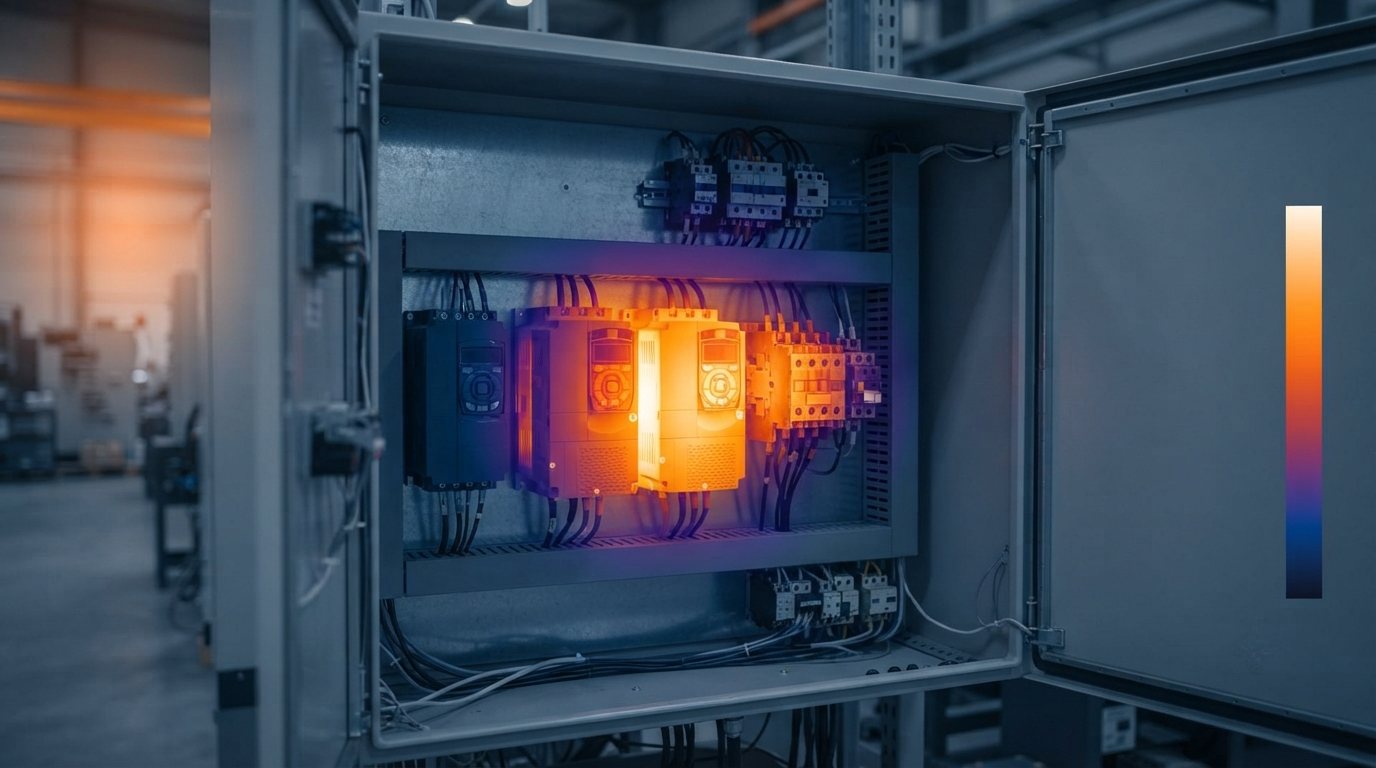
Heat is the quiet killer of electrical panels. A drive that trips on over-temperature every summer afternoon, a PLC that resets for no clear reason, a contactor whose coil burns out early — very often the root cause is a panel running too hot. This guide explains why panels overheat, how to check whether yours will, and the solutions from simple vents to enclosure air conditioners.
Most electrical and electronic devices are rated for an ambient temperature around them of about 40–50 °C, and many derate above that — a VFD may have to reduce its output current, and breakers carry less current before tripping. Electronic components age much faster when hot; a common engineering rule of thumb is that every 10 °C rise roughly halves the life of electrolytic capacitors in power supplies and drives. A panel that sits at 55 °C inside on summer afternoons is quietly shortening the life of everything in it.
The enclosure walls get rid of heat by themselves. For painted sheet steel, a common design value is:
Qwalls ≈ 5.5 × A × ΔT (watts)
where A is the effective cooling surface in m² (which depends on how the enclosure is mounted — a wall-mounted box loses little through its back) and ΔT is the allowed rise of internal temperature above the room. Detailed methods are given in IEC TR 60890 for temperature-rise assessment.
If the internal heat losses are larger than Qwalls, the extra heat must be removed by ventilation or cooling.
For filter fans, a common sizing rule at sea level is:
Airflow (m³/h) ≈ 3.1 × excess heat (W) ÷ ΔT (K)
Here: 3.1 × 175 ÷ 10 ≈ 54 m³/h. Because the filters and outlet grille reduce the flow, choose a fan whose rated airflow with filter meets this figure, usually a fan rated noticeably higher in free air. Always check the actual drive losses in its datasheet.
| Solution | When it works | Limits |
|---|---|---|
| Larger enclosure | Small excess heat, clean indoor rooms | Uses more space; limited gain |
| Natural ventilation louvres | Low losses, clean dry rooms | Lowers IP rating; lets dust in |
| Filter fans with outlet filters | Room air at least 5–10 °C cooler than allowed inside | Cannot cool below room temperature; filters need cleaning |
| Air-to-air heat exchanger | Dusty or oily air that must not enter; room cooler than inside | Cannot cool below room temperature |
| Enclosure air conditioner | Room as hot as or hotter than allowed inside; sealed IP54+ needed | Higher cost; needs condensate management and maintenance |
| Air-to-water heat exchanger | Very high losses, hot or dirty environments with chilled water available | Needs a water supply and leak protection |
VERCHO Engineering Solutions builds enclosures with cut-outs and mounting provisions for filter fans, louvres, heat exchangers and air conditioners, plus sun canopies for outdoor panels. Send us the equipment list and site temperature and we will recommend the enclosure size and cooling arrangement. See VERCHO electrical enclosures or write to info@verchogroup.com.
For any question, please write to us at info@verchogroup.com — or send it straight from this page. Our engineering team will reply by email.