What MCBs, MCCBs, RCCBs and RCBOs each protect against, trip curves, breaking capacity, RCD types and sensitivity, and how to choose the right device.
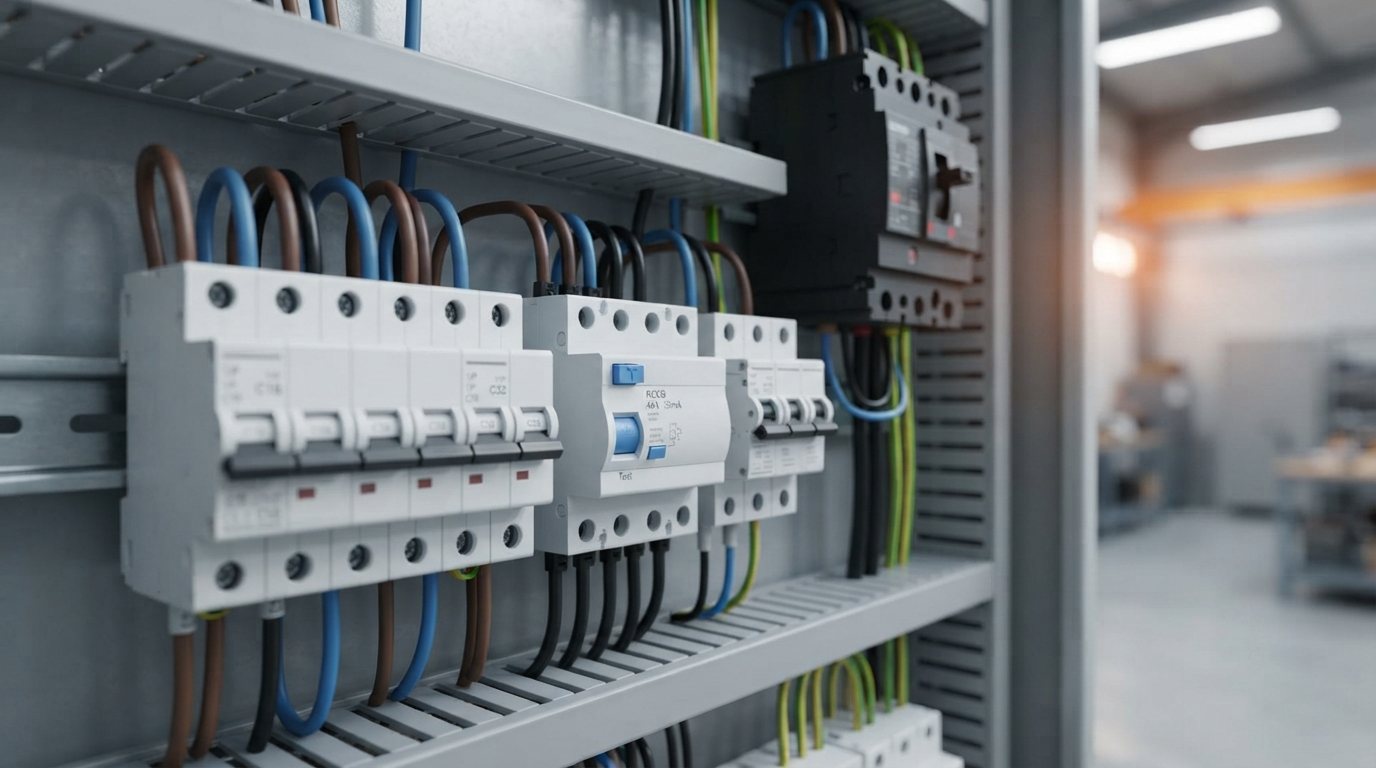
MCB, MCCB, RCCB and RCBO are the four protective devices found in almost every distribution board and control panel. They sound alike and often sit side by side, but each protects against a different danger. This guide explains what each device does, the standards behind them, how to read their ratings, and how to choose the right one.
Electrical protection in low-voltage systems guards against three main faults:
MCBs and MCCBs handle overload and short circuit. RCCBs detect earth leakage only. RCBOs combine both in one device.
| Device | Protects against | Typical current range | Standard | Typical use |
|---|---|---|---|---|
| MCB — Miniature Circuit Breaker | Overload, short circuit | Up to 125 A (most commonly 0.5–63 A) | IEC 60898-1 (IS/IEC 60898-1) | Final circuits: lighting, sockets, small motors, control circuits |
| MCCB — Moulded Case Circuit Breaker | Overload, short circuit (some with earth fault) | About 16–1600 A | IEC 60947-2 (IS/IEC 60947-2) | Incomers and feeders in panels, MCCs, PCCs, large motors |
| RCCB — Residual Current Circuit Breaker | Earth leakage only | Usually 25–100 A | IEC 61008-1 (IS 12640-1) | Group shock and fire protection, with MCBs downstream |
| RCBO — Residual Current Breaker with Overcurrent protection | Overload, short circuit and earth leakage | Usually up to 40–63 A | IEC 61009-1 (IS 12640-2) | Individual circuit protection where one fault must not trip others |
An MCB has a thermal element (a bimetal strip) that trips on sustained overload and a magnetic element (a coil) that trips instantly on short circuit. Its settings are fixed.
The trip curve sets how much current makes it trip instantly:
| Curve | Instant trip at | Use for |
|---|---|---|
| B | 3–5 × In | Resistive loads, lighting, long cable runs, homes |
| C | 5–10 × In | General commercial and industrial loads, small motors, fluorescent and LED lighting |
| D | 10–20 × In | High inrush loads: transformers, large motors, welding sets |
The breaking capacity (rated short-circuit capacity Icn, e.g. 6 kA or 10 kA) must be at least the prospective fault current where the MCB is installed.
An MCCB does the same job as an MCB at higher currents and fault levels, in a larger moulded body. Many MCCBs have adjustable thermal (Ir) and magnetic (Im) settings, and electronic versions add short-time delay and earth fault protection, so they can be coordinated with breakers upstream and downstream.
Two breaking capacities appear on MCCBs under IEC 60947-2:
For important feeders, select an MCCB whose Ics is at least the prospective fault current. MCCBs are also available with motor protection characteristics, shunt trips, undervoltage releases, motor operators and rotary handles for panel doors.
An RCCB compares current going out on the phase(s) with current returning on the neutral. If the difference — the residual current — exceeds its rated sensitivity (IΔn), it trips. It does not protect against overload or short circuit, so it must always be backed by an MCB, MCCB or fuse.
RCCB types describe which leakage waveforms they detect:
Press the test button regularly as recommended by the manufacturer to check the mechanism.
An RCBO is an MCB and an RCD in one device. Each circuit gets its own earth-leakage protection, so a fault on one circuit trips only that circuit — unlike a shared RCCB, which switches off every circuit behind it.
| Application | Common arrangement |
|---|---|
| Home or office distribution board | Main switch or MCB, 30 mA RCCB groups or RCBOs, then MCBs |
| Industrial control panel | MCCB incomer, MCBs or motor protection breakers for outgoings, RCDs for sockets and lighting |
| Power or motor control centre | ACB or large MCCB incomer, MCCB feeders, MCCB/MPCB motor starters |
| Solar and EV charging | Breakers and RCDs of the type the inverter or charger maker specifies, often Type A or B |
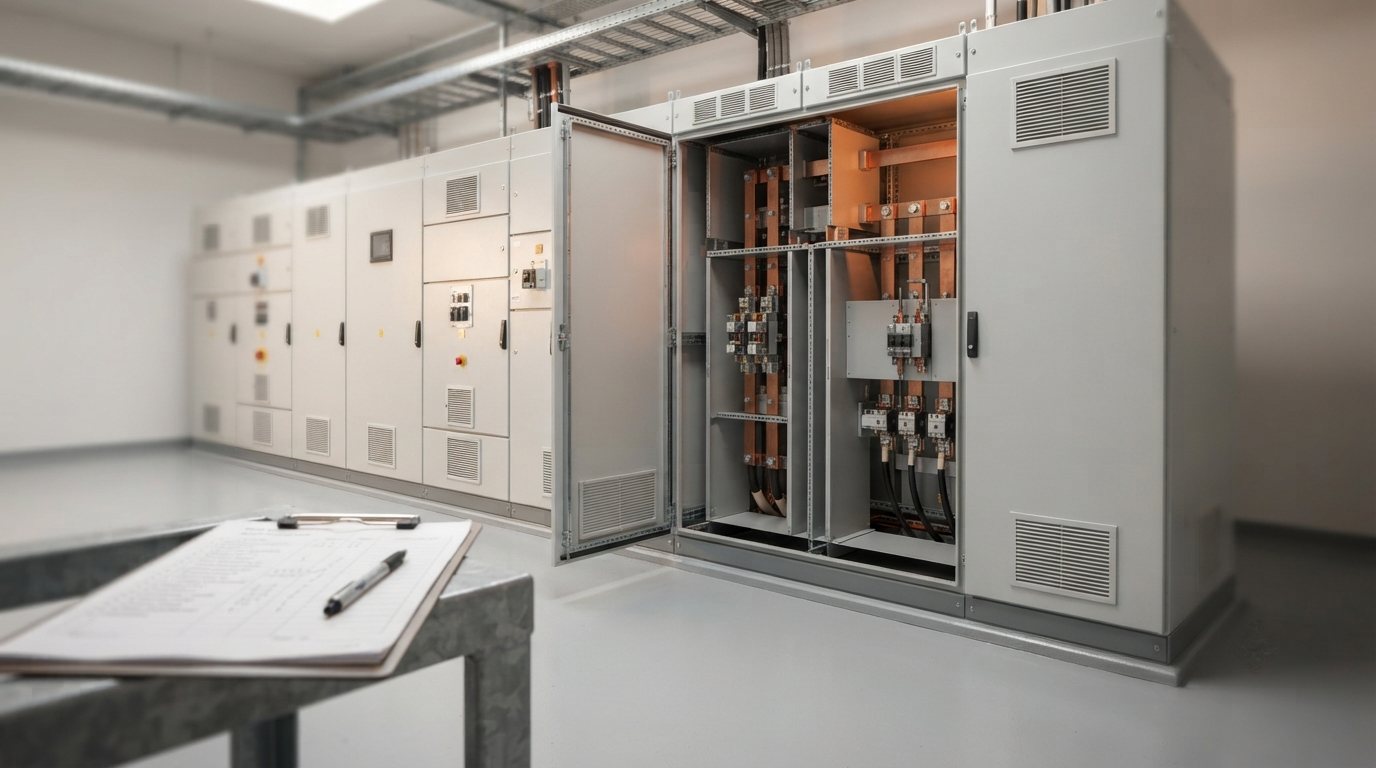
MCBs, MCCBs, RCCBs and RCBOs need the right enclosure and space around them. VERCHO Engineering Solutions builds distribution board and control panel enclosures to suit your switchgear, and VERCHO Enterprises supplies panel components. See how to size a panel enclosure, browse VERCHO electrical enclosures or write to info@verchogroup.com.
This guide is general information. Protection design must follow the local wiring rules (in India, IS 732 and the CEA regulations) and be done by a qualified electrical engineer.
For any question, please write to us at info@verchogroup.com — or send it straight from this page. Our engineering team will reply by email.