Water droplets inside a sealed IP65 panel? Learn why enclosures sweat, how dew point works, and the heaters, hygrostats, breathers and sealing that stop condensation.
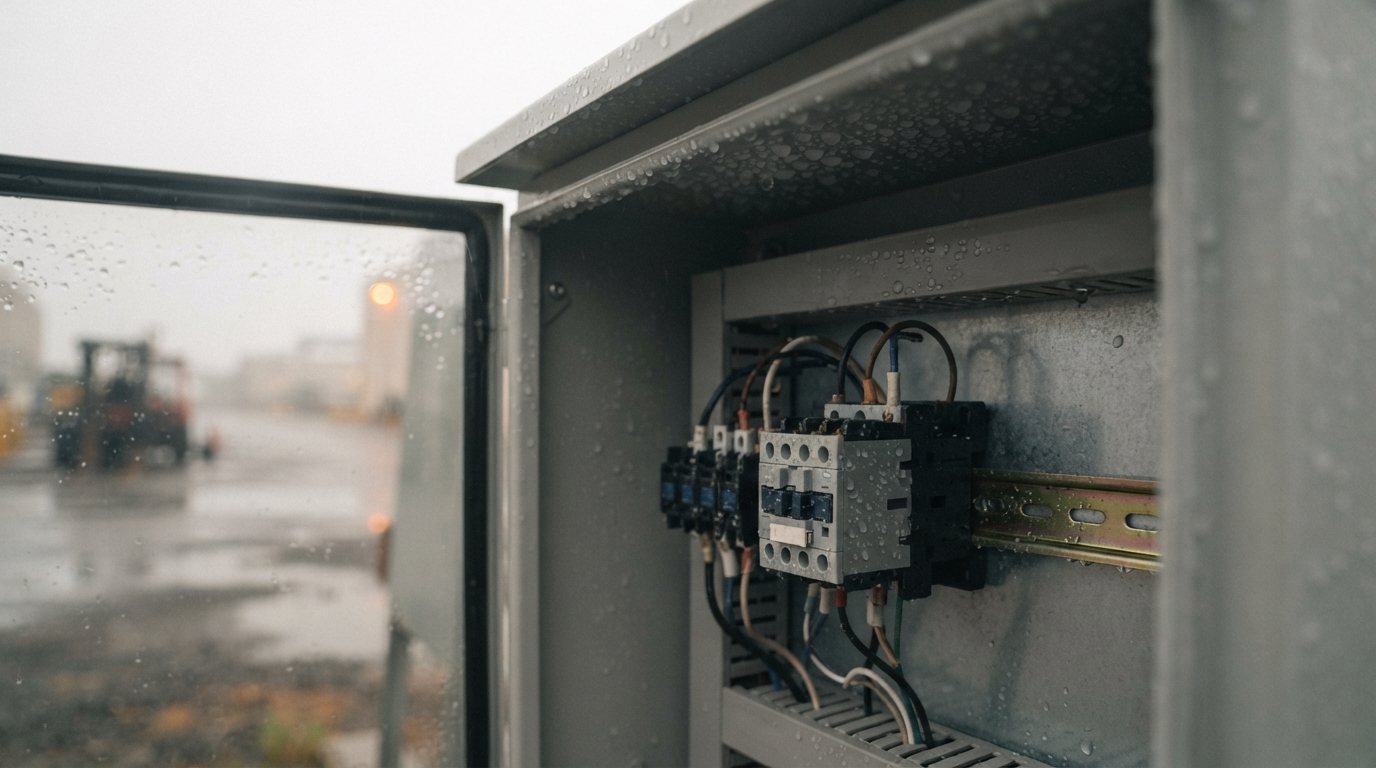
Open an outdoor panel on a monsoon morning and you may find water droplets on the roof, the door and the mounting plate — even though the enclosure is rated IP65 and nothing leaked in. The panel is "sweating". This guide explains why condensation forms inside electrical panels, how dew point works, and the practical fixes that stop it.
Air always holds some water vapour. Warm air can hold more than cold air. When air touches a surface colder than its dew point, it can no longer hold all of its moisture, and the extra water appears as droplets on that surface — exactly like the outside of a cold glass of water.
Inside an enclosure, the coldest surfaces are usually the roof and walls, especially at night or after rain. Water that condenses there drips onto terminals, contactors, PLC cards and busbars.
An IP rating tells you an enclosure keeps out dust and water jets. It does not make the enclosure airtight. As the inside heats up during the day and cools at night, the air inside expands and contracts. Each cooling cycle pulls a little outside air in through door gaskets, cable entries and breathers — and that air brings its moisture with it. Over days, moisture builds up inside a "sealed" box.
Common triggers in Indian plants and sites:
The dew point is the temperature at which air becomes saturated. The more humid the air, the closer the dew point is to the air temperature, and the smaller the drop in surface temperature needed to cause condensation.
| Air temperature | Relative humidity | Dew point (approx.) | Condensation if a surface cools by |
|---|---|---|---|
| 30 °C | 70 % | 23.9 °C | about 6 °C |
| 30 °C | 80 % | 26.2 °C | about 4 °C |
| 28 °C | 85 % | 25.2 °C | about 3 °C |
| 25 °C | 90 % | 23.2 °C | about 2 °C |
| 35 °C | 60 % | 26.1 °C | about 9 °C |
On a humid evening at 28 °C and 85 % RH, a panel roof that cools by just 3 °C under a clear sky will start to sweat. That is why condensation is so common in coastal and monsoon conditions.
A small anti-condensation heater keeps the air inside the enclosure a few degrees above the outside air, so the walls never cool below the dew point. Control it with a thermostat, a hygrostat (humidity switch, often set around 60–65 % RH), or both, so it runs only when needed.
A rough estimate of the heater power needed to lift the inside by ΔT is:
P (W) ≈ k × A × ΔT
where A is the enclosure surface area in m², k is about 5.5 W/m²·K for painted sheet steel, and ΔT is the rise wanted, typically 5–10 K. For an 800 × 600 × 300 mm enclosure (about 1.8 m²) and a 5 K rise: 5.5 × 1.8 × 5 ≈ 50 W. Heat already given off by the equipment inside reduces the heater needed; heater manufacturers publish their own sizing charts.
Breather and drain plugs with a membrane equalise pressure and let condensed water out at the lowest point while keeping the IP rating. Without a drain, water collects on the bottom and gland plate.
Seal cable ducts and the space around cables at the bottom of the panel with sealing compound, foam or a sealing gland plate, so cold damp trench air cannot flow straight into the enclosure. Use correctly sized glands — see our cable glands guide.
An air conditioner removes moisture on its cold evaporator coil and drains it out — but only if the enclosure is well sealed. If the door gasket leaks, the unit keeps pulling in humid air. Do not set the internal temperature lower than needed; around 35 °C inside is usually enough for most electronics and keeps the walls well above the dew point.
Good pretreatment and the right powder coating thickness stop rust where condensation cannot be avoided, and stainless steel 316 or GRP enclosures resist corrosion in coastal plants.
| What you see | Likely cause | First fix |
|---|---|---|
| Droplets on the roof in the morning | Night-time cooling below dew point | Anti-condensation heater with hygrostat |
| Water pooled on the gland plate | No drain; damp air from cable trench | Drain/breather plug; seal cable entries |
| Wet only near the AC unit | Leaking gasket or condensate not draining | Check door seal and AC drain hose |
| Corrosion on terminals, no visible water | Repeated light condensation over months | Heater plus breather; clean and re-torque terminals |
| Panel dry while running, wet after shutdown | Loss of equipment heat | Heater on thermostat during shutdowns |
VERCHO Engineering Solutions builds outdoor and indoor enclosures with canopies, drain and breather provisions, heater mounting space and sealed gland plates. Tell us the site conditions and we will suggest the right enclosure and accessories. See VERCHO electrical enclosures or write to info@verchogroup.com.
Related reading: why electrical panels overheat and IP55 vs IP65 vs IP66.
For any question, please write to us at info@verchogroup.com — or send it straight from this page. Our engineering team will reply by email.