A cross-section of powder coat on sheet steel: what goes wrong below 60 µm and above 120 µm, and how much thickness each environment from indoor rooms to coastal sites really needs.
VERCHO Engineering Team14 Nov 20265 min read
Ask for a powder-coated enclosure and you will usually see "60–80 microns" on the drawing. That number is not arbitrary. Below about 60 µm the coat leaves weak spots where rust starts; well above about 100–120 µm in a single coat it becomes brittle, chips and stops doors fitting. This guide shows what the film looks like in cross-section, why the window matters, and when an installation needs a thicker coating system.
What 60–80 Microns Actually Means
One micron (µm) is a thousandth of a millimetre. A 70 µm powder coat is about the thickness of a sheet of office paper — and it is the only thing between the steel and the weather. The figure is the dry film thickness (DFT): the cured coating, measured after the oven, not the loose powder sprayed on.
Illustration of a powder coat on CRCA sheet steel at three film thicknesses. The coating follows the steel's surface profile, so a thin film leaves peaks, pinholes and edges almost bare.
Why Too Thin Fails
Pinholes and porosity. Powder melts into a film as it cures. A thin layer does not have enough material to close every tiny gap, so moisture and salt reach the steel.
Edges and corners. As the powder melts it pulls away from sharp edges, punched holes and cut corners, so the film there is thinner than on the flat face. If the flat face is only 40 µm, the edges may have very little at all — which is why rust usually starts at edges, hinge cut-outs and gland holes.
Welds and rough spots. Weld spatter and ground areas are rougher than the sheet; their peaks poke through a thin film.
Uneven colour. Light shades such as RAL 7035 look patchy when the film is thin, because the steel and phosphate show through.
Why Too Thick Also Fails
Orange peel and runs — the surface turns wavy and uneven.
Brittleness — a very thick single coat is more likely to crack or chip on impact or when the sheet flexes.
Fit problems — doors bind in their frames, hinges and locks stick, and threads of studs clog.
Gasket sealing — uneven film on the gasket face can stop the gasket compressing evenly, so the enclosure no longer achieves its IP rating.
Wasted powder — extra thickness costs money without adding protection, because protection comes from the coating system, not from piling more of the same powder on.
How Thick Should the Coating Be for Each Installation?
The right thickness depends on where the enclosure will live. The table uses the atmospheric corrosivity categories of ISO 12944-2 / ISO 9223. The thickness values are typical figures used in specifications, not requirements of those standards — your project specification or coating supplier has the final word.
Installation environment
Corrosivity
Typical coating system
Typical total DFT
Indoor, dry, heated control room
C1–C2
Single coat, epoxy-polyester or polyester
60–80 µm
Indoor factory, unheated, some condensation
C2–C3
Single coat polyester, good pretreatment
70–90 µm
Outdoor urban or industrial, inland
C3
Polyester top coat, or primer + polyester
80–120 µm
Outdoor industrial with pollution, or near the coast
C4
Epoxy or zinc-rich primer + polyester top coat
120–160 µm (two coats)
Coastal, marine, chemical plants
C5 / CX
Zinc-rich primer + polyester top coat on galvanised steel, or stainless steel
160 µm and above, or SS 316
Notice that higher protection comes from more coats and better materials — a primer layer, a galvanised base, or a change to stainless steel — rather than from a single very thick coat. For the harshest sites, compare a coated enclosure against stainless steel in our guide to MS vs SS304 vs SS316 enclosures.
Thickness Is Only One Part of the Coating System
A perfect 70 µm film over oily or rusty steel will still peel. Thickness works only together with:
Pretreatment — degreasing, derusting and phosphating (or a zirconium conversion coat) before coating.
The right powder — polyester for anything exposed to sunlight; epoxy and hybrid powders fade and chalk outdoors.
Full cure — the right oven temperature and time for that powder.
Good design — rounded edges, sealed seams and drain points so water does not sit on the coating.
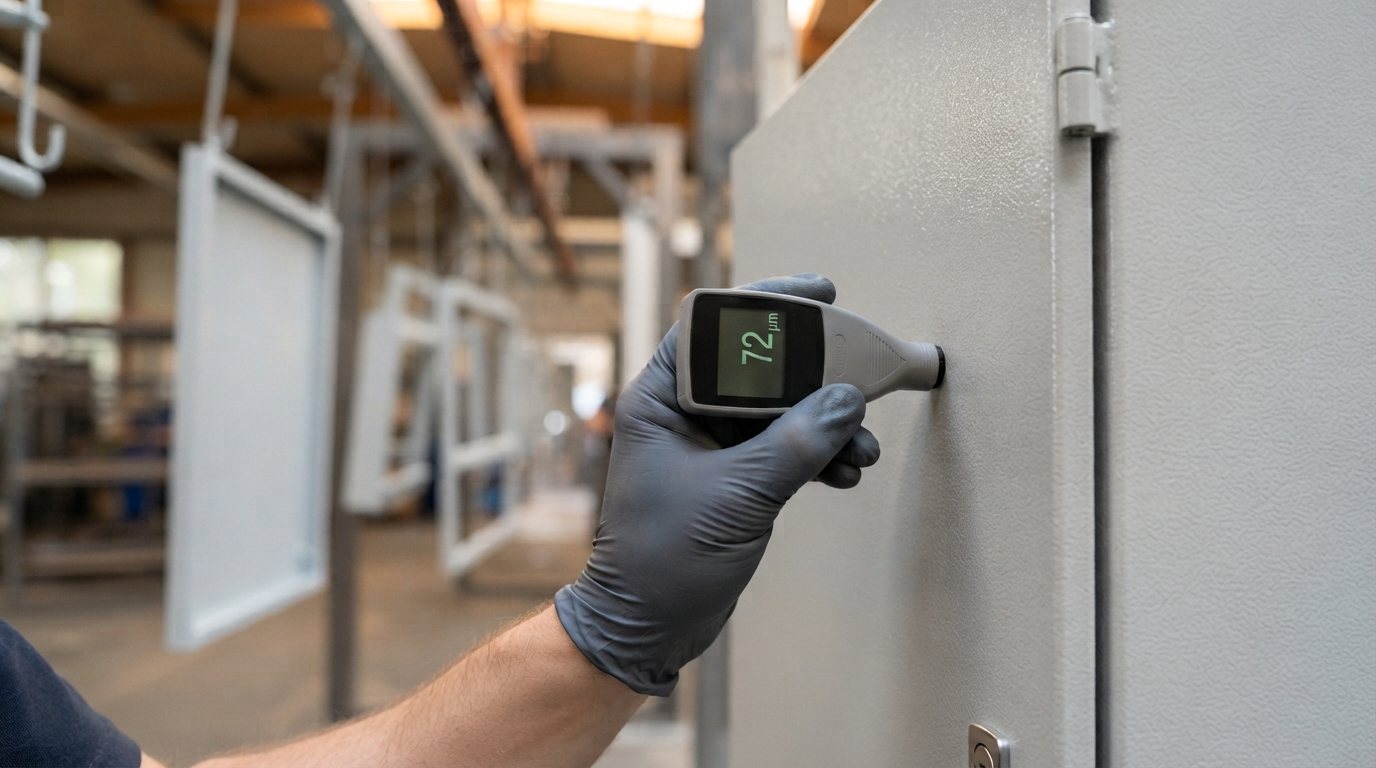
Instrument: a calibrated magnetic-induction gauge for steel (eddy-current for aluminium), checked against reference foils before use, as described in ISO 2808.
Where: on every face of the body, door and covers — not only on a flat test panel — including near edges and inside corners.
How many: several readings per part, recorded on the inspection report.
Acceptance: a common approach, from ISO 19840 for protective coatings, is the "80/20" rule: the average must meet the nominal thickness, no more than 20 % of readings may fall below it, and none may fall below 80 % of it.
A Checklist for Your Enclosure Specification
Installation environment and corrosivity category (C1 to C5 / CX).
Coating system: single coat, or primer + top coat.
Nominal DFT range, for example 60–80 µm for indoor use.
Powder type: polyester for outdoor, hybrid acceptable indoors.